Rock VPN: Fast & Secure
- 4.7
- Rating
- 10.00K
- Installs
- Free
- Price

 Analysis by App-foxy
I tested Rock VPN: Fast & Secure as a social-category utility from Stergo, and my first impression was that it is aimed at people who want a quick privacy layer without turning VPN setup into a technical project. The app is free to install, carries an Everyone age rating, and its promise is easy to understand: connect through a VPN proxy when you are using public Wi-Fi, browsing away from home, or trying to keep your IP address less exposed. That simplicity is its strongest appeal, but it also means I would not treat it as a complete answer to every privacy concern.
Rock VPN has a 4.6 average from around 154 ratings, with more than 10K installs. Those figures suggest a modest but positive user base rather than the broad track record of the biggest VPN names. The app was released on January 12, 2026, and the current version is 3.3.0, so I see it as a relatively new option that deserves practical testing rather than automatic trust. In my experience, that is exactly how a smaller privacy app should be judged: by how clearly it fits into daily routines, how little friction it creates, and whether its limits are easy to understand.
How Rock VPN fits into a shared household
The most useful way I can imagine using Rock VPN is on a shared device that moves between different networks. Picture a household tablet used at home, in a café, and during travel. One person may use it for ordinary browsing, another for messaging, and someone else for a game or video service. Turning on a VPN before joining an unfamiliar hotspot gives the device a more consistent privacy habit, instead of relying on each household member to understand network risks separately.
You May Also Like

 AccuWeather: Weather Radar
AccuWeather Review: A Quick, Clear Forecast for Everyday Decisions
For everyday plans, the best forecast is the one you can understand quickly. AccuWeather makes rain timing, radar, and local conditions easy to act on, with a few trade-offs.

 Hill Climb Racing
Why Hill Climb Racing Still Turns Crashes Into One More Run
A tiny car, a bumpy hill and one more upgrade: Hill Climb Racing keeps resurfacing because its simple chaos makes every near-miss feel personal.

 AliExpress - Shopping App
AliExpress Makes Global Shopping Feel Personal, but Shoppers Bear the Risk
AliExpress turns a global marketplace into a pocket-sized discovery engine. Its reach is useful, its shopping loop compelling, and its trade-offs easy to miss.

 Lords Mobile: Kingdom Wars
Lords Mobile Is a Kingdom-Building Routine, Not a Quick Match
A case-by-case verdict on the building, battles, device demands, and social commitments that make Lords Mobile rewarding for some players and exhausting for others.

 PDF Scanner app - TapScanner
TapScanner Makes Paperwork Easier to Capture, Check, and Share
TapScanner makes scanning with a phone feel less like a rescue operation and more like a dependable step in getting work done. Its capture tools are useful, though not flawless.

 Block Blast!
 Shows How Much a Puzzle Game Can Leave Out
A quiet grid game shows why puzzle players increasingly value instant clarity, repeatable skill and low-pressure play—and where the genre still needs to catch up.
More From Our News Desk
View All News


That shared-device scenario also exposes an important boundary: Rock VPN protects the network connection of the device while it is active, not every person in the household as a separate account. If several people use one phone or tablet, the app does not automatically create distinct privacy profiles for them. I would therefore agree on a simple household routine: the person taking the device outside turns the VPN on before connecting to public Wi-Fi, and turns it off later only when there is a clear reason.
I would not assume that installing the app on one family member’s phone protects another person’s phone. Each device needs its own setup if the goal is consistent coverage. That sounds obvious, but shared homes often blur the difference between a shared internet connection and a shared app installation. Rock VPN belongs to the device where it is installed, so coordination matters more than any supposed family-wide effect.
There is also a practical benefit for people who are not comfortable with network settings. A fast-connect style VPN is easier to hand to a parent, teenager, or occasional traveler than a complicated manual configuration. I found that the real value is not merely encryption as a technical concept; it is making a safer connection routine easy enough that people actually remember to use it.
What happens before the first connection
Setup is best approached with realistic expectations. Rock VPN is free to start, which removes the biggest barrier for someone who wants to try a VPN without committing money first. The app includes in-app purchases ranging from $4.99 to $49.99 per item, so I would pay attention to every purchase screen and make sure the person using a shared device understands when an optional upgrade is being offered.
That matters especially on a family tablet. A free installation does not mean every part of the experience is necessarily free, and a child or guest should not be left to interpret purchase prompts alone. I would handle any subscription or upgrade decision through the device owner’s normal approval process. This is not a criticism unique to Rock VPN; it is simply good practice whenever a privacy tool includes paid options and multiple people share access to the same device.
The minimum operating-system requirement is Android 9, which makes the app relevant to a range of older Android phones as well as newer models. Before installing it on a household device, I would still check the exact system version and available storage, then test the connection at home first. A VPN that works well in one network environment can behave differently on a crowded café hotspot, a school network, or a hotel connection.
My recommended first test is deliberately boring. Open a few ordinary websites, check a messaging app, and try the services the device is used for most often. Then disconnect Rock VPN and repeat the same routine. This gives you a baseline for speed, access, and reliability without confusing a network problem with an app problem. It is also a better test than judging the app only by whether its connect button changes state.
Boundaries I would set on a shared phone
I would make three rules clear from the beginning. First, the VPN is a connection tool, not a replacement for screen locks, careful passwords, or sensible app permissions. Second, it should not be used to hide unsafe behavior from the device owner. Third, if a website or service behaves strangely after connection, the user should report it rather than repeatedly tapping buttons or buying an upgrade in frustration.
Those rules are particularly useful when a teenager and a parent share a device. The Everyone rating makes Rock VPN broadly suitable from an age-label perspective, but an age rating does not establish trust between household members. A VPN can reduce exposure on a network while also making it harder for another person to understand where traffic is going. I would explain that privacy and secrecy are not identical, and I would agree on when the app should be active.
For a work phone used by several people, I would be more cautious. A VPN may affect business login pages, video calls, banking checks, or internal services that expect the ordinary network path. Rock VPN can be useful for general browsing on that phone, but I would not activate it blindly before an important work session. A separate personal device is the cleaner arrangement whenever household use and professional access overlap.
The key household boundary is simple: Rock VPN can protect a connection, but it cannot create trust, supervision, or separate identities. Keeping that distinction visible prevents the app from being oversold as a family-management product.
Coordinating everyday use without making it complicated
In a busy home, the best VPN is the one people can coordinate around. I would choose a shared phrase such as “turn it on before public Wi-Fi,” rather than asking everyone to remember technical details. That covers libraries, cafés, airports, hotels, and other places where the network owner may be unfamiliar. At home, the decision can be more flexible because the household already controls the router and understands who is using it.
A useful workflow is to connect before opening sensitive services, not after. If someone is about to check email, send private messages, or sign in on a public hotspot, I would have them activate Rock VPN first, wait for the connection indicator, and only then open those apps. This reduces the chance of beginning a session on an exposed network and assuming the VPN was already running.
I would also teach users to notice interruptions. If the VPN disconnects, the person should avoid assuming that the phone silently restored the same protection. Pause, check the app, and decide whether to reconnect or postpone the task. This small habit is more valuable than telling people to leave a VPN running constantly without understanding what happens when the connection changes.
For streaming and gaming, the trade-off becomes more noticeable. Rock VPN’s store summary specifically presents it for streaming and gaming, but a VPN can change the route between the device and a service. That may help in some network situations and create slower loading, higher latency, or access friction in others. I would test the particular game or streaming service at the time and place where it is normally used, rather than assuming the advertised use case will feel identical for everyone.
Gaming is especially sensitive because a small delay can matter more than privacy convenience. If the household wants protection while downloading a game or using public Wi-Fi, Rock VPN may be a sensible experiment. If the priority is competitive play with the lowest possible latency, I would compare a normal connection and the VPN connection before deciding. The right choice may change from one activity to another.
Streaming has its own complication. Services can react differently to VPN traffic, and content availability may depend on the service’s own rules. I would not buy a paid option solely because I expect it to unlock every catalog or solve every playback problem. Test the service you actually use, and treat location-changing expectations with caution rather than as a guaranteed feature.
How it compares with familiar alternatives
Compared with using ordinary public Wi-Fi without a VPN, Rock VPN offers a clear extra layer for the network connection and hides the device’s usual IP address from sites that see the VPN connection instead. That makes it more useful than simply trusting the hotspot because it has a familiar name. I would still avoid entering sensitive information on suspicious pages, because a VPN does not make phishing sites legitimate.
Compared with a browser-only privacy extension, Rock VPN is more relevant when several apps need protection, not just web browsing. A browser tool may be easier for someone who only wants to change browser behavior, while a device-level VPN is more convenient for mixed use involving messaging, games, and other apps. The trade-off is that a device-wide connection can affect more services at once, so troubleshooting may take longer.
Compared with a large, established VPN provider, Rock VPN is easier to try without an upfront purchase and may feel less intimidating for casual users. The downside is that its smaller install base and newer release history give me less long-term perspective than I would have with a mature service. For ordinary hotspot protection, that may be an acceptable trade-off. For journalists, frequent travelers handling sensitive work, or anyone who needs extensive server choices and highly documented policies, I would investigate a more established alternative before relying on it.
A private DNS setting is another alternative, but it solves a different problem. DNS protection can help prevent some name-resolution snooping, while a VPN proxy is intended to cover more of the connection and mask the visible IP address. I would not treat either option as a universal privacy shield. Rock VPN is the more approachable choice when the goal is a quick, broad connection change, but it still belongs alongside secure passwords, updated software, and careful browsing.
Age, trust, and the limits of shared privacy
The Everyone rating makes the app easy to consider for a household, but I would introduce it differently depending on the user’s age. With an adult, I would focus on hotspot safety, connection checks, and the possibility that some services may behave differently. With a teenager, I would add a conversation about why the VPN is being used and what it does not conceal from websites, apps, or the device owner.
For a younger child, I would keep control of installation and purchases with the adult who owns the device. Rock VPN does not become a parental-control system simply because it is installed on a child’s phone. It does not replace conversations about online behavior, account safety, or which services are appropriate. If the household needs filtering, activity supervision, or detailed child profiles, I would look for a dedicated family-safety product instead.
Account boundaries deserve equal attention. If one person installs Rock VPN under their store account, another person using the same device may still encounter the app and its settings. I would avoid sharing purchase credentials, and I would explain who is responsible for changing connection settings. That prevents a common household problem in which one person thinks the VPN is always active while another has disabled it for a game or video call.
Trust also affects whether the app is appropriate at all. A household member may want privacy from public networks but not from the people who manage the device. Those are separate expectations. I would recommend Rock VPN when the family can agree on transparent use, not when someone is trying to create an invisible communication channel on a shared phone.
One non-obvious advantage of this approach is that it turns the app into a teachable routine. Instead of presenting VPNs as mysterious tools that “hide everything,” parents can show children how a connection changes, why public hotspots deserve caution, and why privacy tools do not remove personal responsibility. That lesson is more durable than simply installing the app and never discussing it again.
When I would skip Rock VPN
I would skip it for someone who wants a fully documented, long-established VPN ecosystem and expects extensive controls before making any decision. I would also hesitate for a user whose main need is advanced network customization, detailed device policies, or a carefully managed business deployment. Rock VPN’s appeal is its approachable, fast-starting role, not a promise of enterprise administration.
I would also skip it if the only reason for installing a VPN is to solve unreliable internet. A VPN cannot repair a weak signal, overloaded router, or poor mobile coverage. In some cases it can add another step between the device and the service, so troubleshooting the underlying network should come first. The same applies to gaming: if every millisecond matters, test the connection rather than assuming the VPN will improve it.
Finally, I would not use any VPN as permission to ignore account security. Rock VPN can help on a risky hotspot, but it cannot stop someone from giving a password to a fake login page, downloading a malicious file, or reusing the same password everywhere. Its role is narrower and more useful when understood clearly.
My household verdict
After using Rock VPN with shared-device needs in mind, I see it as a practical starting point for people who want a straightforward VPN proxy without paying before trying the basic experience. Its free entry point, Android 9 compatibility, and Everyone rating make it easy to introduce in a household, while the current version, 3.3.0, gives users a clear point of reference when checking whether their installation is up to date.
The app is a good fit for a family tablet that travels between trusted home networks and unfamiliar hotspots, or for an adult who wants a simple privacy step before browsing, messaging, streaming, or gaming away from home. I especially like the idea of using it as part of a shared routine rather than leaving each person to make a technical decision from scratch.
My reservations are just as important. The app does not replace family controls, separate accounts, secure browsing habits, or a reliable home network. Its effect can vary by service, and gaming or streaming may require a direct comparison before you settle on a routine. The presence of purchases from $4.99 to $49.99 per item also means the device owner should supervise upgrades, particularly when children or guests use the same screen.
Overall, I would recommend Rock VPN to casual users who value convenience and want an accessible way to add privacy on public Wi-Fi. I would choose a more established or specialized alternative for demanding professional privacy, advanced administration, or highly sensitive work. Used with honest expectations and clear household boundaries, Rock VPN: Fast & Secure is a sensible tool for safer everyday connections—not a magic cloak for every online activity.
FAQs for Rock VPN: Fast & Secure
01What is Rock VPN: Fast & Secure, and how does it work?
Rock VPN: Fast & Secure is a virtual private network app designed to route your internet traffic through a VPN server instead of connecting directly to websites and online services. This can help mask your IP address, improve privacy on public Wi-Fi, and provide access to servers in different locations. However, like any VPN, it does not make you completely anonymous or protect you from every online threat.
02Is Rock VPN: Fast & Secure free to use?
Rock VPN: Fast & Secure may offer free VPN access, but availability of servers, connection speeds, usage limits, advertisements, and premium features can depend on the current version of the app. Before downloading, check its Google Play or App Store listing for subscription details and in-app purchases. Also review the renewal terms carefully if you choose a paid plan, since subscriptions may renew automatically.
03Does Rock VPN: Fast & Secure keep logs of my online activity?
The app’s privacy practices should be checked in its current privacy policy before use, because VPN providers can differ considerably in the information they collect. Look for details about connection logs, browsing activity, IP addresses, device identifiers, and diagnostic data. A VPN can improve network privacy, but you should not assume that all activity is automatically private unless the provider clearly explains its data-retention policy.
04Can Rock VPN: Fast & Secure unblock streaming services, websites, or games?
Rock VPN: Fast & Secure may allow you to connect through servers in different regions, which can help with certain network restrictions or location-based access. Nevertheless, streaming platforms and websites frequently detect and block VPN addresses, so performance is not guaranteed. Connection speed can also vary by server congestion, distance, and your mobile network. Always follow the terms of service for the content or game you access.
05Will Rock VPN: Fast & Secure slow down my internet connection or drain my battery?
Using a VPN can cause a small reduction in speed because your traffic is encrypted and routed through an additional server. In testing, the effect generally depends on the selected location, network quality, and server load. Keeping a VPN connection active may also increase battery and data usage slightly. For the best experience, choose a nearby server and disconnect the app when secure tunneling is no longer needed.
Pros
- Simple one-tap connection makes it easy for beginners.
- Works over both Wi-Fi and mobile data networks.
- Useful for accessing content on restricted networks.
- Low-friction interface with minimal setup required.
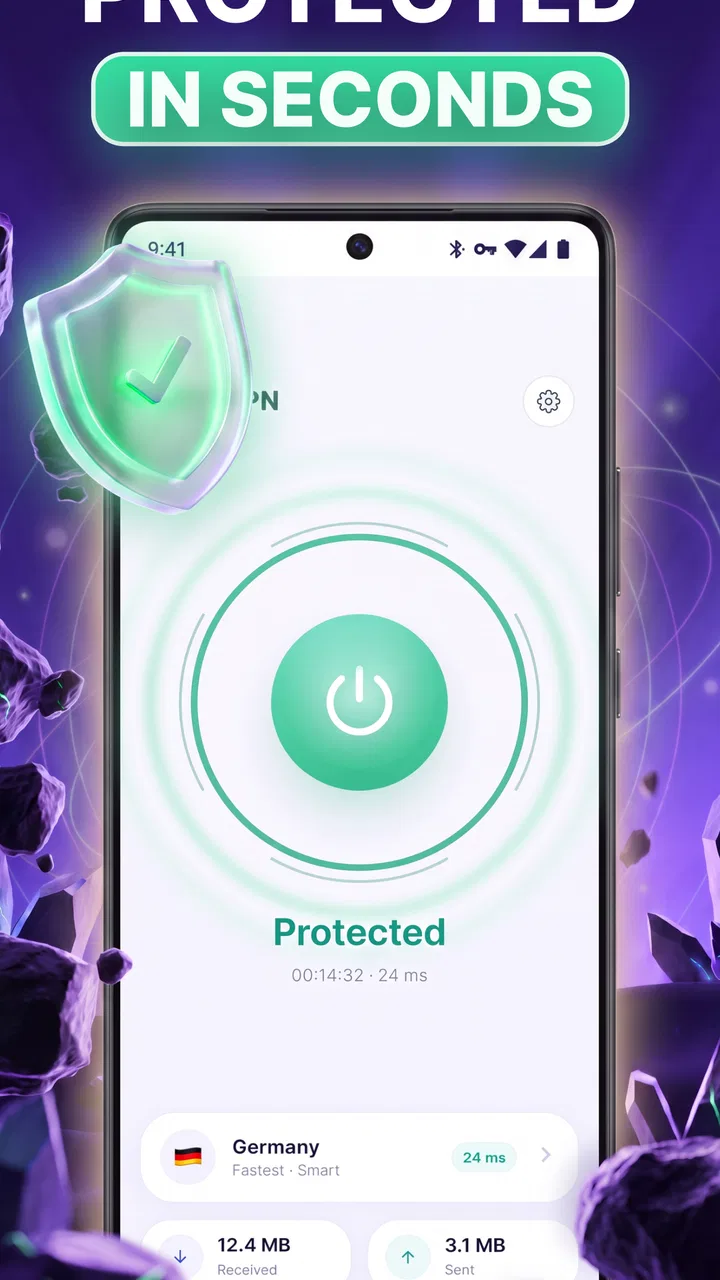
- Connection status is clearly visible while browsing.
Cons
- Free servers may become crowded during peak hours.
- Some locations may deliver inconsistent connection speeds.
- The app may use noticeable battery during extended sessions.
- Advanced VPN controls are limited for experienced users.
- You may need to reconnect after switching between networks.

Rock VPN: Fast & Secure
Gallery